


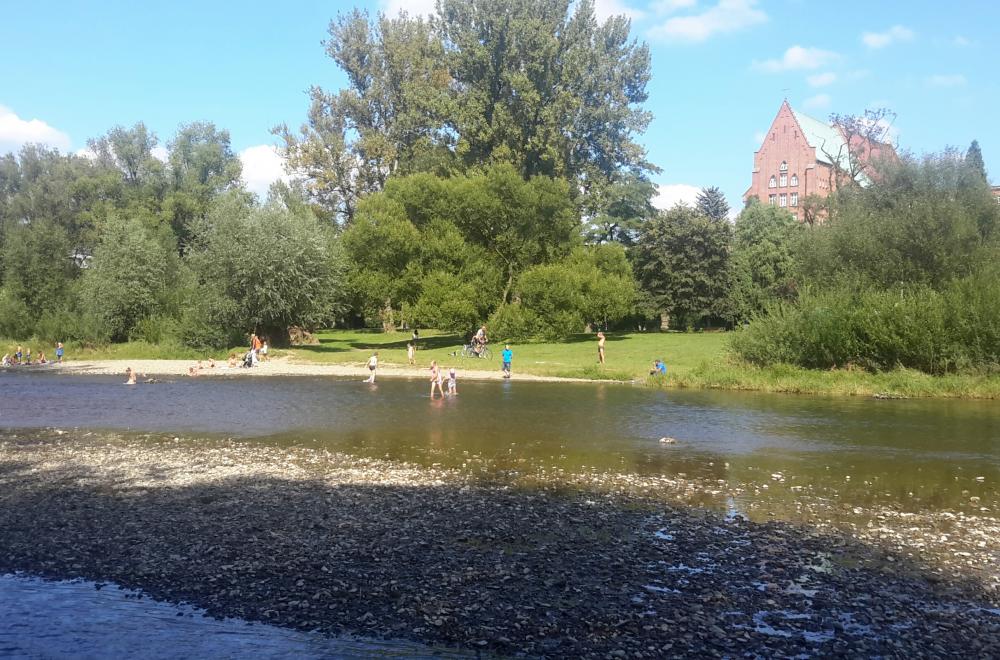
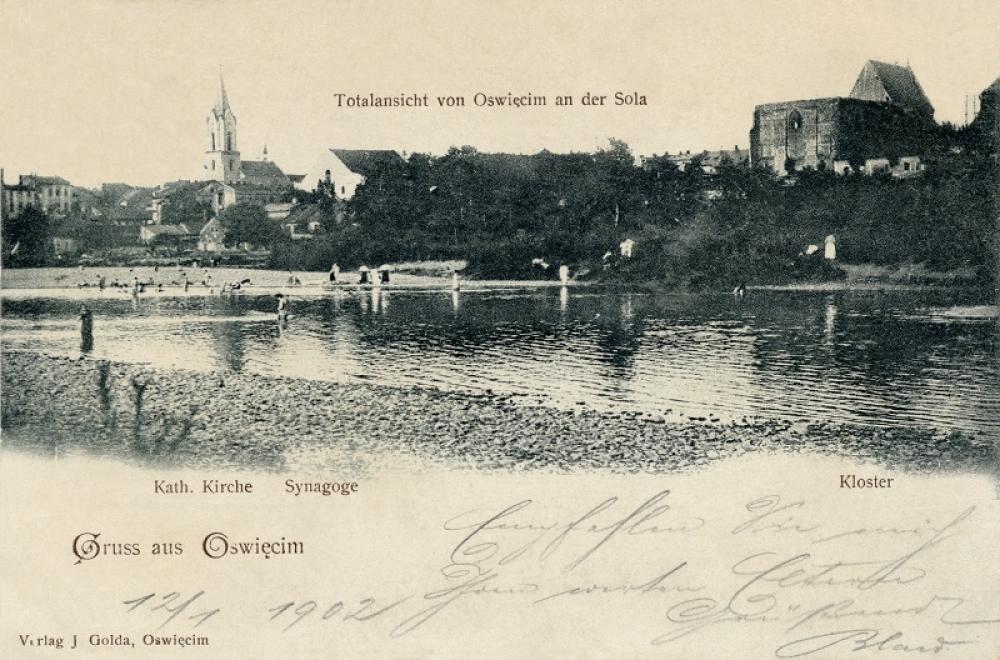
View of Oświęcim 1900
On the picture you can see the catholic church, the Great synagogue and the Salesian monastery, standing quite close to each other. On the today picture we can see that the view of Oświęcim changed a lot. Only the church remained, the synagogue was completely demolished in the 2nd World War and the monastery was turned into a bigger church. There is a new park by the riverside with trees that nowadays cover the view that once was visible. We can also see a little bit of the castle on the left side of the picture.
The site from where the today picture was taken is now dangerous to walk on, so we advise you not to visit it.
Oświęcim is today a 40,000 peoples town located in the Soła river valley. Therefore it has always been an important location for trading routes (especially salt route).
Oświęcim's history starts in the 11th century with a settlement on the castle hill and around the year 1272 the town received municipal rights which were confirmed by the duke of Cieszyn, Mieszko I, on 3rd September 1291. In 1457 the Duchy of Oświęcim was incorporated into the Polish Crown. Half a century later, a huge fire destroyed the castle and it was rebuilt in 1534. On the 2nd half of the 16th century, the first settlement of Jews appeared in the town and a Jewish community was formed with a synagogue and a cemetery. The Jewish inhabitants called their town Oshpitzin, taken from the Hebrew word for "guests".
The town was invaded by the Swedes in 1655 and was inhabited by no more than 200 people until the 18th century. With the first partition of Poland in 1772, Oświęcim belonged to Galicia and was under the rule of the Austrian Empire until Poland regained independence in 1918.
Before the 2nd World War about 14,000 people lived in Oświęcim and more than half of the population were Jews (around 60%). The relations between the inhabitants were mostly peaceful, also some anti-Semitic incidents occurred in 1918 and in the 1930s. In the town were around 20 synagogues and prayer houses.
During the 2nd World War Oświęcim was under German occupation and the town was annexed in the German Reich. Oświęcim was renamed Auschwitz and in spring 1940 the Germans established the Auschwitz concentration camp - firstly for Polish political prisoners, since 1942 the place served as the site of mass extermination of the European Jews. In 1941 all Jewish inhabitants of Oświęcim were deported to nearby ghettos in Będzin, Charnów and Sosnowiec and most of them were murdered later in the Auschwitz-Birkenau concentration camp.
On 27th January 1945 Oświęcim and the concentration camp were liberated from German occupation. In 1947 at the site of the former camp, the Auschwitz-Birkenau State Museum in Oswiecim was founded.
After the 2nd World War only a few Jewish inhabitants could return to the town - most of them were murdered in the Holocaust. In the year 2000 the last Jewish inhabitant, Szymon Kluger, died. Today there is no Jewish community in Oświęcim.
| Ort | Oświęcim |
| Autor | ASF Summer Camp... |
| Kategorien | Stadtbild Tourismus Kirche/Kloster Synagoge Schule/Bildung Brücke/Fluss Wiederaufbau |
| Suchbegriffe / Tags | |
| Lizenz | Alle Rechte vorbehalten |
| Bildquelle | |
| Urheber | Unknown; collection Tomasz Daczyński |
| Urheber Vergleichsbild | |
| Lizenz Vergleichsbild | Unbeschränktes Nutzungsrecht (Public Domain) |