


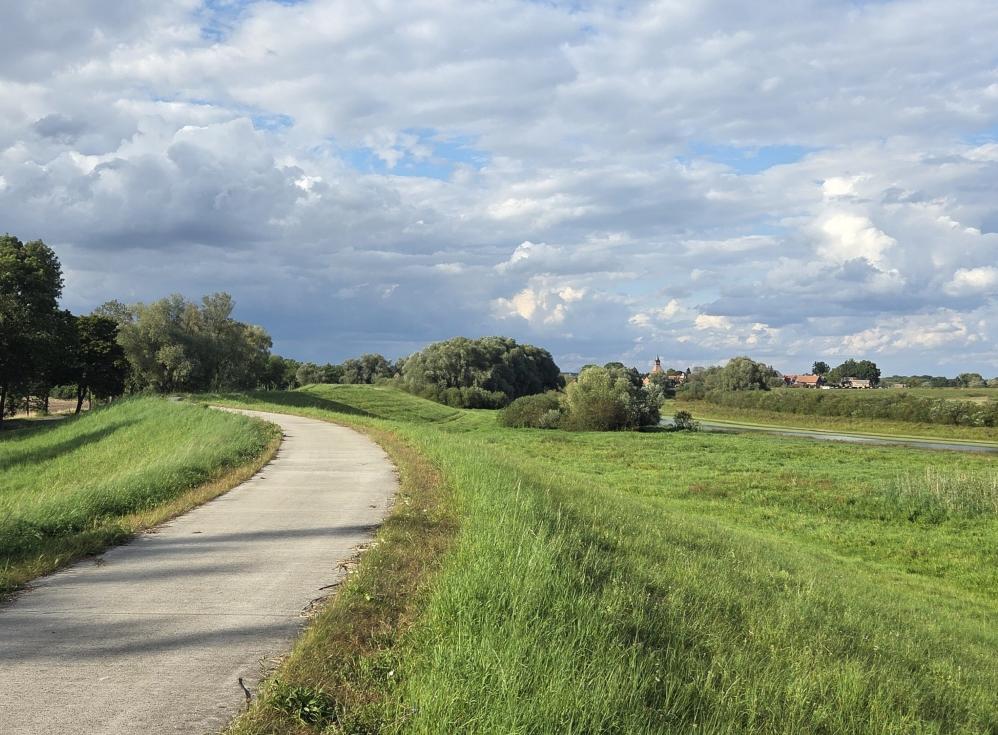
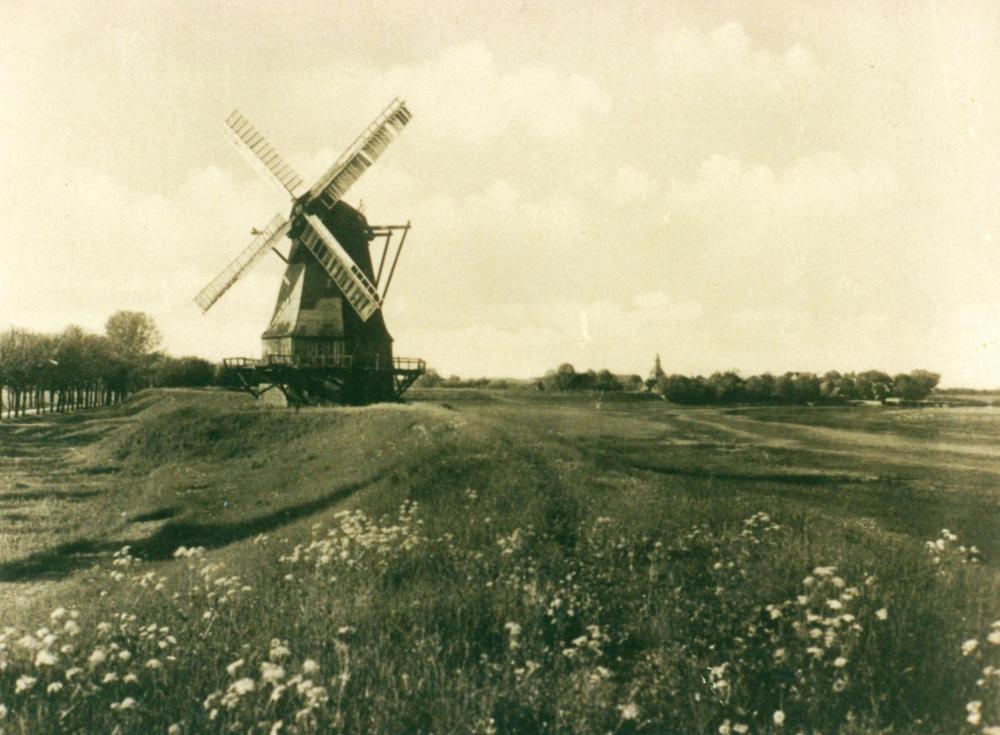
Windmühle um 1920
English version below
Im 18. Jahrhundert gab es in Schnackenburg drei Mühlen: Eine Bockwindmühle, eine Roßmühle und eine Schiffsmühle. Bei der Schiffsmühle handelte es sich um eine durch ein zwischen zwei Schiffen befestigtes Schaufelrad betriebene Mühle. Da diese Schiffsmühle im Jahr 1791 untergegangen war, erwogen das Amt Schnackenburg und die Königliche Kammer in Hannover einen Neubau. Letztendlich entschied man sich für eine holländische Windmühle. Rudolf Haberland zitiert dazu in seinem Buch "Geschichte des Grenzgebietes Gartow-Schnackenburg" von 1961 folgenden Beschluss des Stadtrates Schnackenburg: "Nach genauer Erwägung aller Umstände finden wir es am geratensten, statt einer neuen Schiffs- oder zweiten Bockwindmühle eine zu allen Bedürfnissen hinreichende holländische Windmühle zu erbauen, und haben den bisherigen Mühlenpächter Kerstens dahin vermocht, daß er den Bau auf eigenen Kosten übernehmen will."
Weiterhin beschreibt Haberland: "Die Landesherrschaft hatte nichts gegen die gemachten Vorschläge einzuwenden, aber es gingen doch noch über 3 Jahre ins Land, bis die neue Mühle fertig war. Es mußte noch mit dem Gericht Gartow über den Bauplatz auf dem Alanddeich unterhandelt werden und mit dem Müller Kerstens über einen neuen "Erbenzinsvertrag." Am schwierigsten aber war es , ein "Subjekt zu finden, welches der Construction solcher Mühlen kundig sei." Endlich entschloß man sich, einem Zimmermeister aus Gartow, der nach Berichten des Amtmannes Jacobi ein sehr geschickter Mann war, die Ausführung des Mühlenbaus zu übertragen, welcher ihn dann auch im Spätherbst des Jahres 1796 glücklich zu Ende führte. [...] Nach einem Bericht des Amtes Gartow an die Landdrostei vom 08. Dezember 1868 gab es zu Beginn des Jahres 1865 in Schnackenburg eine holländische Mühle und eine Bockwindmühle. [...] Die Holländermühle war 1848 nach Aussage des Müllers in einer amtlichen Verhandlung erst ganz neu erbaut worden." Die ursprüngliche Mühle soll 1840 abgebrannt sein.
1866 wird die Mühle zwangsversteigert. Die Beschreibung in dem sog. Subhastations-Patent lautet: "1. eine holländische Windmühle, mit Weizen-, Roggen- und Graupengang, 1846 neu erbaut, mit massivem, etwa 10 Fuß hohen Fundament, und einem Bretterverschlag von der Schwickstelle bis zum Rohrdach, versichert in der Landesbrandcasse zu 4000 Thalern." (Quelle: https://www.wendland-archiv.de/details/Galerieholl%C3%A4nderm%C3%BChle/52060).
Die Windmühle wurde zuletzt vom Müller Gilberg bis 1939 betrieben und 1940 abgebrochen (Quelle: Geschichte des Grenzgebietes Gartow-Schnackenburg, Rudolf Haberland, 1988, S. 276).
© 2026 Stephan Prieß
In the 18th century, there were three mills in Schnackenburg: a post mill, a horse mill, and a boat mill. The boat mill was powered by a paddle wheel mounted between two boats. After this boat mill sank in 1791, the Schnackenburg administrative office and the Royal Chamber in Hanover considered building a replacement. Ultimately, they decided on a Dutch windmill. In his 1961 book "Geschichte des Grenzgebietes Gartow-Schnackenburg" (History of the Gartow-Schnackenburg Border Region), Rudolf Haberland quotes the following resolution passed by the Schnackenburg town council: "After careful consideration of all circumstances, we deem it most advisable—rather than constructing a new boat mill or a second post mill—to build a Dutch windmill capable of meeting all requirements; we have persuaded the current mill lessee, Kerstens, to undertake the construction at his own expense."
Haberland further describes the situation: "The territorial authorities had no objections to the proposals made, yet more than three years elapsed before the new mill was completed. Negotiations still had to be conducted with the Gartow court regarding the building site on the Aland dike and with the miller, Kerstens, concerning a new hereditary lease agreement. The greatest challenge, however, was finding an individual 'versed in the construction of such mills.' Finally, the decision was made to entrust the construction to a master carpenter from Gartow—a highly skilled man, according to reports by the bailiff, Jacobi—who successfully completed the project in the late autumn of 1796. [...] According to a report from the Gartow administrative office to the regional authority ("Landdrostei") dated December 8, 1868, there were a Dutch-style windmill and a post mill in Schnackenburg at the beginning of 1865. [...] The Dutch-style mill had only recently been built in 1848, according to the miller's testimony during an official hearing." The original mill reportedly burned down in 1840.
In 1866, the mill was sold at a forced auction. The description in the so-called auction decree reads: "1. a Dutch windmill, with milling sets for wheat, rye, and pearl barley, newly built in 1846, featuring a solid foundation approximately 10 feet high and timber boarding extending from the tailpole area up to the thatched roof; insured with the state fire insurance fund for 4,000 thalers." (Source: https://www.wendland-archiv.de/details/Galerieholl%C3%A4nderm%C3%BChle/52060).
The windmill was last operated by the miller Gilberg until 1939 and was dismantled in 1940 (Source: "Geschichte des Grenzgebietes Gartow-Schnackenburg", Rudolf Haberland, 1988, p. 276).
© 2026 Stephan Prieß
| Ort | Schnackenburg |
| Autor | Stephan |
| Kategorien | Stadtbild Erinnern Brücke/Fluss Abriss |
| Suchbegriffe / Tags | |
| Lizenz | Alle Rechte vorbehalten |
| Bildquelle | Rundlingsverein Wendland |
| Urheber | Unbekannt |
| Urheber Vergleichsbild | |
| Lizenz Vergleichsbild | Alle Rechte vorbehalten |
| Zugeordnete Touren | Durch die Jahrhunderte/Through the Centuries Leben an den Flüssen/Life Along the Rivers |