


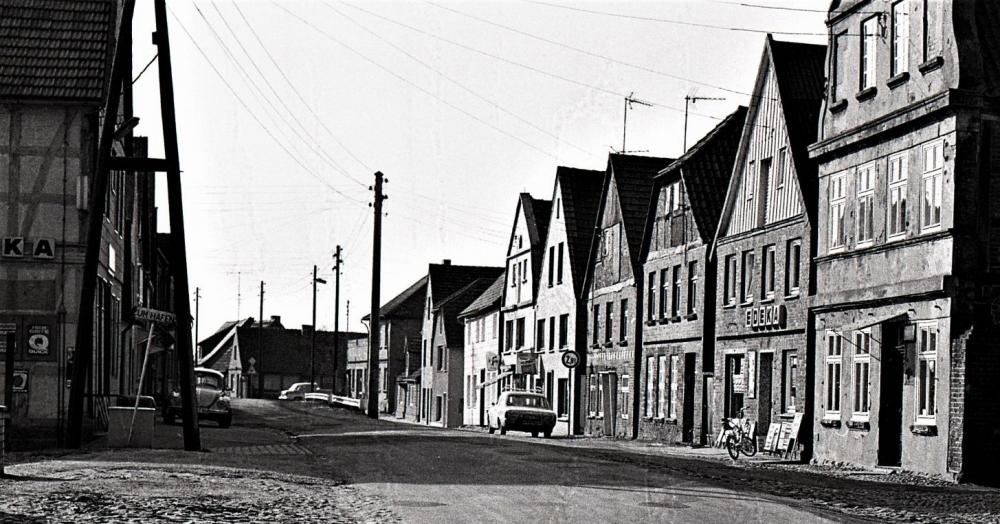
SPIEGEL-Artikel um 1976
English version below
Der SPIEGEL-Artikel „Da geht es links und rechts nicht weiter“ ist 1976 erschienen und richtet den Blick exemplarisch auf die Kleinstadt Schnackenburg im Landkreis Lüchow-Dannenberg und nutzt sie als Sinnbild für die strukturelle Randlage weiter Teile des innerdeutschen Grenzgebiets. Schnackenburg wird dabei weniger als Einzelfall denn als Verdichtung jener politischen, wirtschaftlichen und demografischen Probleme beschrieben, die viele Gemeinden am damaligen Ostrand der Bundesrepublik prägten.
Im Jahr 1976 ist Schnackenburg eine Stadt mit kaum mehr als 600 Einwohnern. Ihre geografische Lage bestimmt maßgeblich ihre Situation: Direkt an der innerdeutschen Grenze gelegen, endet hier nicht nur das Verkehrsnetz, sondern auch ein Großteil wirtschaftlicher Entwicklungsmöglichkeiten. Die Elbe markiert nicht nur eine natürliche Grenze, sondern eine politische Trennlinie, die Schnackenburg faktisch zur Sackgasse macht. Straßen führen nicht weiter, Bahnverbindungen fehlen, und selbst regionale Zentren sind nur mit erheblichem Aufwand zu erreichen. Diese Abgeschiedenheit verleiht der Stadt den im Artikel zitierten Charakter einer Endstation, an der „links und rechts nichts weitergeht“.
Die wirtschaftliche Lage Schnackenburgs und im gesamten Landkreis Lüchow-Dannenberg ist 1976 entsprechend angespannt. Industrie existiert praktisch nicht, größere Arbeitgeber fehlen vollständig. Die wenigen Erwerbsmöglichkeiten liegen im lokalen Handwerk, in kleinen Dienstleistungsbetrieben oder in der Landwirtschaft. Viele Bewohner sind gezwungen, für Arbeit in weiter entfernte Orte zu pendeln oder die Region ganz zu verlassen. Besonders junge Menschen sehen kaum Zukunftsperspektiven, was zu einer deutlichen Überalterung der Bevölkerung führt. Der Artikel beschreibt eine Region, in der Rentner und ältere Ehepaare den öffentlichen Raum dominieren, während Kinder und Jugendliche zunehmend fehlen.
Die demografische Entwicklung wirkt sich unmittelbar auf das städtische Leben Schnackenburgs aus. Schulen sind von Schließung bedroht oder bereits zusammengelegt, Geschäfte kämpfen ums Überleben, und kulturelle Angebote beschränken sich auf Vereine und traditionelle Veranstaltungen. Schnackenburg erscheint 1976 als Ort, der vor allem von seiner Vergangenheit lebt, nicht aber von einer klaren Vorstellung seiner Zukunft. Selbst staatliche Förderprogramme können diesen Trend kaum aufhalten. Zwar fließen Mittel zur Grenzraumförderung, doch reichen sie nicht aus, um nachhaltige wirtschaftliche Impulse zu setzen oder neue Arbeitsplätze zu schaffen.
Besonders deutlich wird im Artikel, dass Schnackenburg nicht nur ökonomisch, sondern auch mental an den Rand gedrängt ist. Die Grenze zur DDR erzeugt ein Gefühl des Abgeschnittenseins, das über materielle Probleme hinausgeht. Die Stadt liegt im Schatten der deutschen Teilung, ohne von ihrer politischen Bedeutung zu profitieren. Während andere Grenzorte zumindest symbolische Aufmerksamkeit erhalten, bleibt Schnackenburg weitgehend unbeachtet. Der Alltag ist geprägt von Stillstand, Routine und dem Bewusstsein, in einer Region zu leben, aus der es kaum Wege hinausgibt.
Gleichzeitig schildert der Artikel aber auch den sozialen Zusammenhalt der verbliebenen Bevölkerung. Vereine, Nachbarschaften und persönliche Netzwerke halten das städtische Leben aufrecht. Diese Strukturen wirken stabilisierend, können jedoch die grundlegenden strukturellen Probleme nicht kompensieren. Schnackenburg erscheint 1976 als Stadt, die funktioniert, ohne sich zu entwickeln – ein Ort des Verharrens statt des Aufbruchs.
Insgesamt zeichnet der SPIEGEL-Artikel ein nüchternes und ungeschöntes Bild Schnackenburgs im Jahr 1976. Die Stadt steht exemplarisch für die Folgen geografischer Randlage, politischer Teilung und fehlender wirtschaftlicher Perspektiven. Schnackenburg wird so zum Symbol eines Grenzraums, der trotz staatlicher Aufmerksamkeit kaum Anschluss an die Dynamik der Bundesrepublik findet. Der Artikel macht deutlich, dass es sich hierbei nicht um ein vorübergehendes Problem handelt, sondern um eine tiefgreifende strukturelle Krise, die das Leben und die Zukunft der Stadt nachhaltig prägt.
Der SPIEGEL-Artikel ist in der Ausgabe 29/1976 erschienen und hier abrufbar.
© 2026 Stephan Prieß
The SPIEGEL article “It doesn't go any further left or right” was published in 1976 and focuses on the small town of Schnackenburg in the Lüchow-Dannenberg district as an example and uses it as a symbol for the structural peripheral location of large parts of the inner-German border area. Schnackenburg is described less as an isolated case than as a condensation of the political, economic and demographic problems that characterized many communities on what was then the eastern edge of the Federal Republic.
In 1976, Schnackenburg is a town with barely more than 600 inhabitants. Their geographical location largely determines their situation: Located directly on the inner-German border, not only the transport network ends here, but also a large part of economic development opportunities. The Elbe not only marks a natural border, but also a political dividing line that effectively makes Schnackenburg a dead end. Roads don't lead any further, there are no rail connections, and even regional centers can only be reached with considerable effort. This isolation gives the city the character quoted in the article of a terminus where “nothing goes left or right”.
The economic situation in Schnackenburg and in the entire Lüchow-Dannenberg district was correspondingly tense in 1976. Industry is practically non-existent and larger employers are completely absent. The few employment opportunities are in local crafts, in small service businesses or in agriculture. Many residents are forced to commute to more distant places for work or to leave the region entirely. Young people in particular see little future prospects, which is leading to a significant aging of the population. The article describes a region in which pensioners and older couples dominate public spaces, while children and young people are increasingly absent.
Demographic developments have a direct impact on urban life in Schnackenburg. Schools are threatened with closure or have already closed, businesses are struggling to survive, and cultural offerings are limited to clubs and traditional events. In 1976, Schnackenburg appears as a place that lives primarily from its past, but not from a clear idea of its future. Even government funding programs can hardly stop this trend. Although funds are flowing to promote border areas, they are not enough to provide sustainable economic stimulus or create new jobs.
The article makes it particularly clear that Schnackenburg is marginalized not only economically, but also mentally. The border with the GDR creates a feeling of being cut off that goes beyond material problems. The city lies in the shadow of the German division without benefiting from its political importance. While other border towns receive at least symbolic attention, Schnackenburg remains largely ignored. Everyday life is characterized by standstill, routine and the awareness of living in a region from which there are hardly any ways out.
At the same time, the article also describes the social cohesion of the remaining population. Clubs, neighborhoods and personal networks maintain urban life. These structures have a stabilizing effect, but cannot compensate for the fundamental structural problems. In 1976, Schnackenburg appears as a city that functions without developing - a place of staying instead of moving forward.
Overall, the SPIEGEL article paints a sober and unadorned picture of Schnackenburg in 1976. The city is an example of the consequences of geographical peripherality, political division and a lack of economic prospects. Schnackenburg thus becomes a symbol of a border area that, despite state attention, hardly connects with the dynamics of the Federal Republic. The article makes it clear that this is not a temporary problem, but a profound structural crisis that has a lasting impact on the life and future of the city.
The SPIEGEL article appeared in issue 29/1976 and is available here.
© 2026 Stephan Prieß
| Ort | Schnackenburg |
| Autor | Stephan |
| Kategorien | Stadtbild Erinnern |
| Suchbegriffe / Tags | |
| Lizenz | Alle Rechte vorbehalten |
| Bildquelle | Wendland-Archiv |
| Urheber | Otto Kiehn |
| Zugeordnete Touren | Die deutsche Teilung/Division of Germany |