


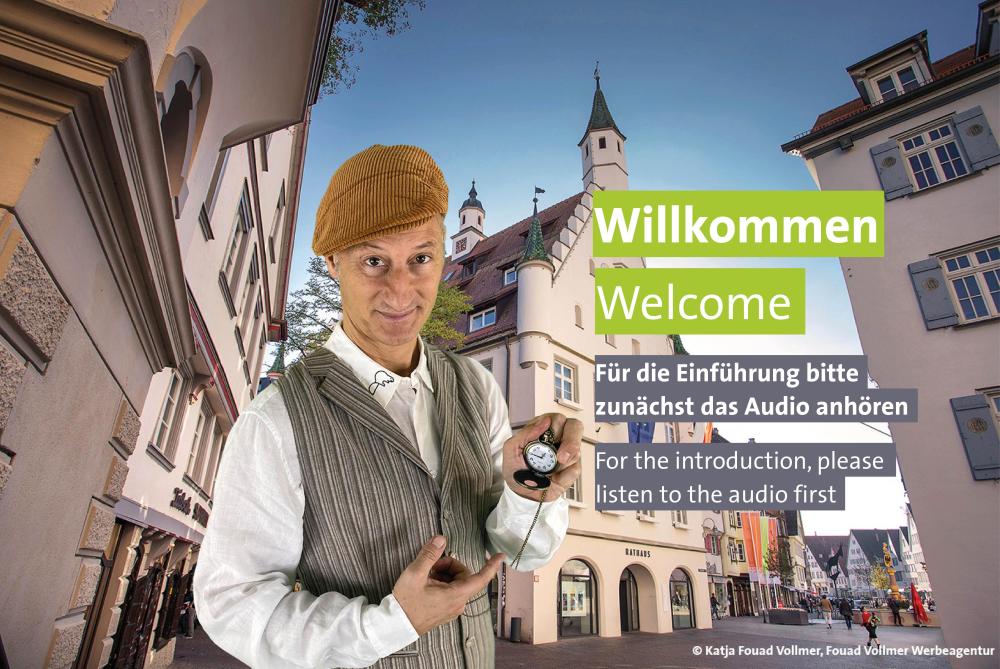
The Old and New Town Hall
Audio:
Welcome! May I introduce myself? I am your guest guide. I will accompany you through the beautiful town of Biberach and take you on a journey through its history.
Well, my dear husband, people immediately noticed that this is a beautiful town. But you know, they want to hear about how the people of Biberach live and what they experience, that's what we need to tell them. The rest they can see for themselves.
You're absolutely right. Yes, the people of Biberach not only work hard but also know how to celebrate. Think of the Biberach Schützenfest – ten days and ten nights, a centuries-old tradition.
Biberach an der Riß is located in the heart of Upper Swabia, between Ulm and Ravensburg. The former Free Imperial Town has chosen the motto "small-strong-Upper Swabian" and follows in the tradition of its patricians, who traveled as long-distance merchants throughout Europe between the 14th and 16th centuries. The former splendor of this time is evident in the imposing bourgeois houses around the spacious marketplace, the towering baroque-style St. Martin's Church from the 14th century, two medieval town halls, two granaries for the secular and ecclesiastical authorities, and the remains of the town fortifications. The centerpiece, the "White Tower”, still watches over the town today. The money for all this splendor was earned with high-quality fustian, a fabric made of cotton and linen, which up to 400 weavers worked on diligently day after day in their "Dunken", the weaving cellars. The weaver's quarter has been preserved in rare completeness. Small alleys invite you to stroll, the hospital grounds draw your attention with two small churches and a museum, which boasts an Ernst Ludwig Kirchner cabinet and Dinglinger jewels. An insider's tip is the original artists' workshops, with a unique collection of antiques and paintings from the 19th-century Munich School of Painting.
Today, prosperity is based on modern industry: Boehringer Ingelheim, Liebherr, Handtmann, KaVo, Vollmer and Gerster. The town grew from 4,000 inhabitants in the Middle Ages to almost 35,000 today. A wide range of public and private kindergartens, schools, high schools, as well as a nationally renowned university, complement the options for education and study. Biberach has preserved the charm of a small Swabian town, whether at the Schützenfest, the historical children's and folk festival, during the chit-chat Saturdays and Wednesdays at one of the largest and most beautiful weekly markets in the region, or at the “Christkindleralau”, the descent of the Christ Child, a unique Biberach tradition on Christmas Eve. The Alps and Lake Constance are never far away. Curious? Biberach awaits you.
We can do everything. Even High German, English, French, Italian, and if necessary, speak with hand gestures! Didn't understand anything? No problem. Just come, click, and start walking. It's worth it.
Two stops on the tour are not accessible to people with disabilities - Gigelberg with the Gigelturm, no. 8, and the White Tower, no. 9. Alternatively, the next stop, Weberberg, is accessible from Ochsenhauser Hof. Both stations can be listened to there and at any other location. But now it's time to meet... in the past! Let's dive deep into the stories and events. The tour is approximately two and a half kilometers long and takes about 1.5 hours. Enjoy!
Video:
Dear guests, people have been coming here since ancient times. But where does the name "Biberach" come from? "ach" means stream, the watercourse where people settled, and where beavers once had their home.
A document takes us back to the year 1083. It was the Staufer Emperor Frederick Barbarossa who acquired the property of the Lords of Biberach around 1170. Towards the end of the 13th century, Biberach became an Imperial Town and from 1404, a Free Imperial Town. In 1802, after the Napoleonic Wars, Biberach fell to the Margraviate of Baden and four years later to the Kingdom of Württemberg.
The townscape is shaped by not one but two stately town halls. The Old Town Hall was built in 1432 near the marketplace. Just 70 years later, a new, stone town hall stood in the marketplace. Thus, the people of Biberach showed their neighbors in Ulm that they could afford a "late Gothic town palace" and were "stone-rich" – which means very rich in local dialect.
In the basement of the Old Town Hall, there was space for butchers to sell meat. The New Town Hall, on the other hand, had open sales halls for bread on the ground floor. Butchers and bakers were thus under the supervision of the town.
Today, the ground floor of the Old Town Hall is no longer the bakery but Tourist Information. Here, you can book guided tours with my colleagues.
Visit our classic and themed tours at https://tourismus.biberach-riss.de/Experience-Biberach/Guided-city-tours Biberach souvenirs are available from the Tourist Information Centre, Marktplatz 7/1, 88400 Biberach an der Riß.
Do you have beautiful photos of places, squares or buildings in Biberach? Share your pictures and impressions on social media using #visitbiberach. We look forward to seeing them!
Music: Patrick Stolz
| Ort | Biberach an der Riß |
| Autor | Tourismus Biberach |
| Kategorien | Stadtbild Tourismus Rathaus |
| Suchbegriffe / Tags | |
| Lizenz | Alle Rechte vorbehalten |
| Bildquelle | |
| Urheber | Katja Fouad Vollmer, Fouad Vollmer Werbeagentur |
| Zugeordnete Touren | StadtGschichtla aus Biberach Digital City Tour Biberach Histoires de la ville de Biberach Storie di città da Biberach |