


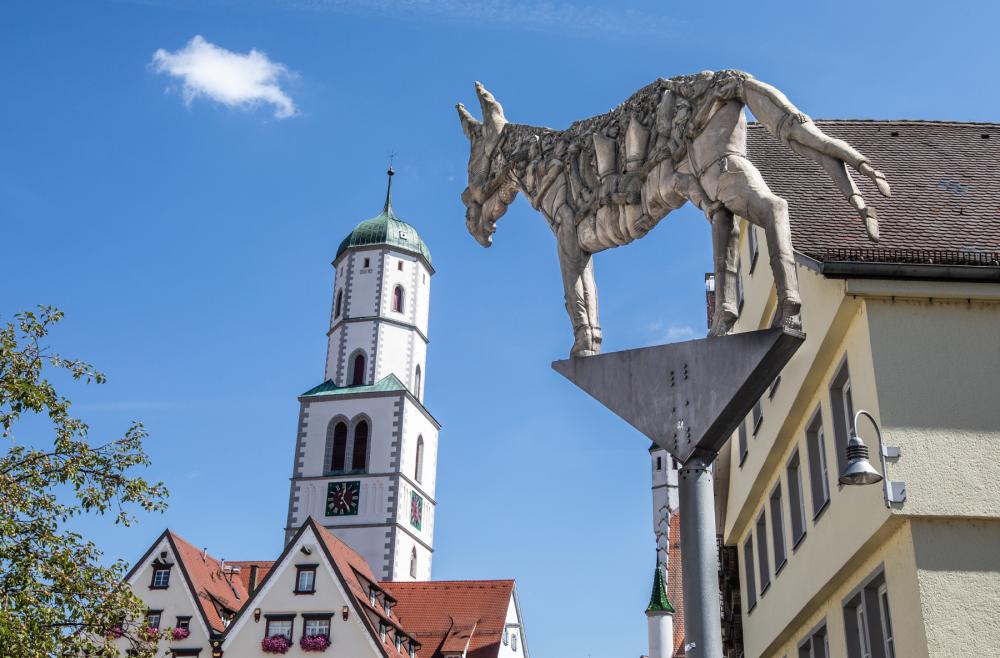
Marketplace and Donkey
Here, at the marketplace amidst magnificent patrician houses, the people of Biberach have always gathered for historic assemblies, to buy goods of all kinds or simply to have a chat.
The Biberach marketplace is like the town's living room, as you can see from all these wonderful gabled houses, the quintessential townscape. The absolute highlights are the Gutermann houses with the church in the background. It's worthwhile to look occasionally up from your phone here; you'll notice that on some buildings there are saintly statues. This has only tangentially something to do with religion. It's simply marketing. Biberach, mainly a Protestant town, had to show where the Catholic pharmacy was. So the Catholic pharmacist has a religious statue, so that the Catholic trader from Ulm doesn’t accidentally buy Protestant headache tablets.
Perhaps you've already noticed the oldest and most majestic house on the corner. The Cloverleaf House belonged to very wealthy long-distance merchants and was completed in 1362/63. Carriages could enter below. Above were the offices, a large apartment, a floor for the staff, and finally, the warehouse space at the top.
Of course, our panoramic view wouldn't be complete without the answer to why there's a donkey on Biberach's marketplace. The reason is our town's most famous son, Christoph Martin Wieland, poet, thinker, and Enlightenment figure, born in 1733 in Oberholzheim near Biberach, and who died in 1813 in Weimar.
In his "History of the Abderites", you'll find the tale of the "Trial of the Donkey's Shadow." In short, it's about whether one must pay additionally for using the shadow. The senseless dispute leads to the donkey's death and the ancient Greek republic of "Abdera" to the brink of destruction. A monument to self-correction for bourgeois town society. It was created by the artist Peter Lenk.
But let's hear from the artist himself:
"Well, I value Wieland – former satirist, 250 years old. And in the back, the violence; in the belly, dogma; in the head, sex – that's how Wieland's donkey appears, asking, who is actually the donkey, and who else must be nuts? That's the brief version of the explanation text."
You can learn more about this during any guided tour and on the information board near the donkey.
Further information is available at the Wieland Museum of the town of Biberach at http://www.wieland-museum.de/en/the-wieland-museum.html, which is located in the poet's original garden house. If you would like to follow in Wieland's footsteps, you can use the interactive map of the Wieland Society as a guide: www.wieland-gesellschaft.de/alles-ueber-wieland#wieland_spuren
| Ort | Biberach an der Riß |
| Autor | Tourismus Biberach |
| Kategorien | |
| Suchbegriffe / Tags | |
| Lizenz | Alle Rechte vorbehalten |
| Bildquelle | Kreismedienzentrum Biberach |
| Urheber | Alexander Kohler |
| Zugeordnete Touren | StadtGschichtla aus Biberach Digital City Tour Biberach Histoires de la ville de Biberach Storie di città da Biberach |