


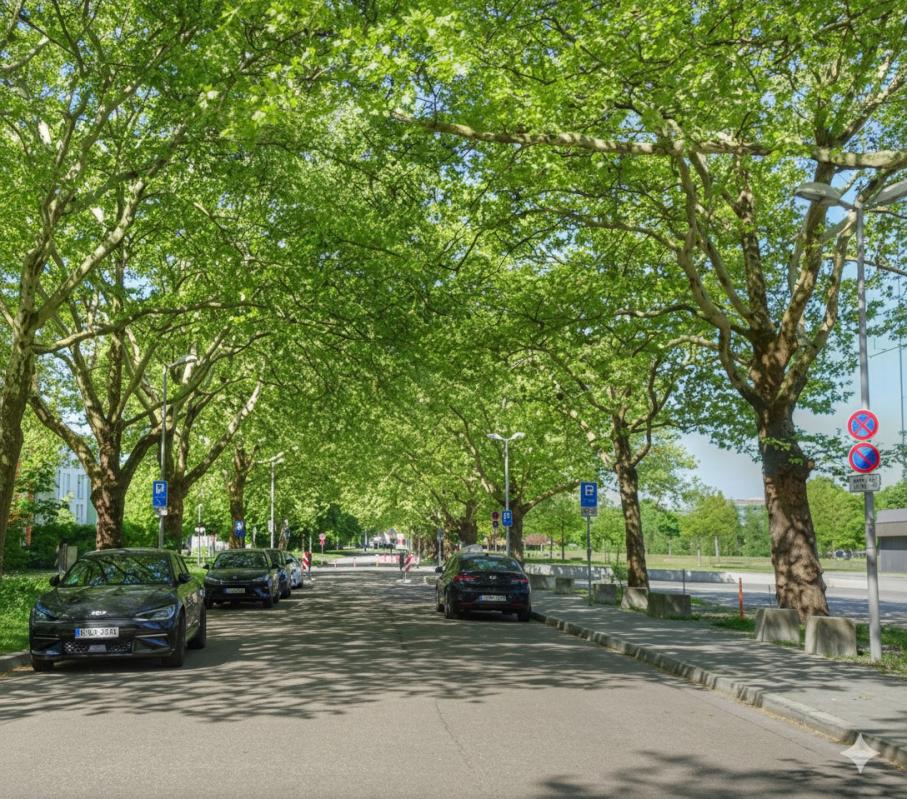
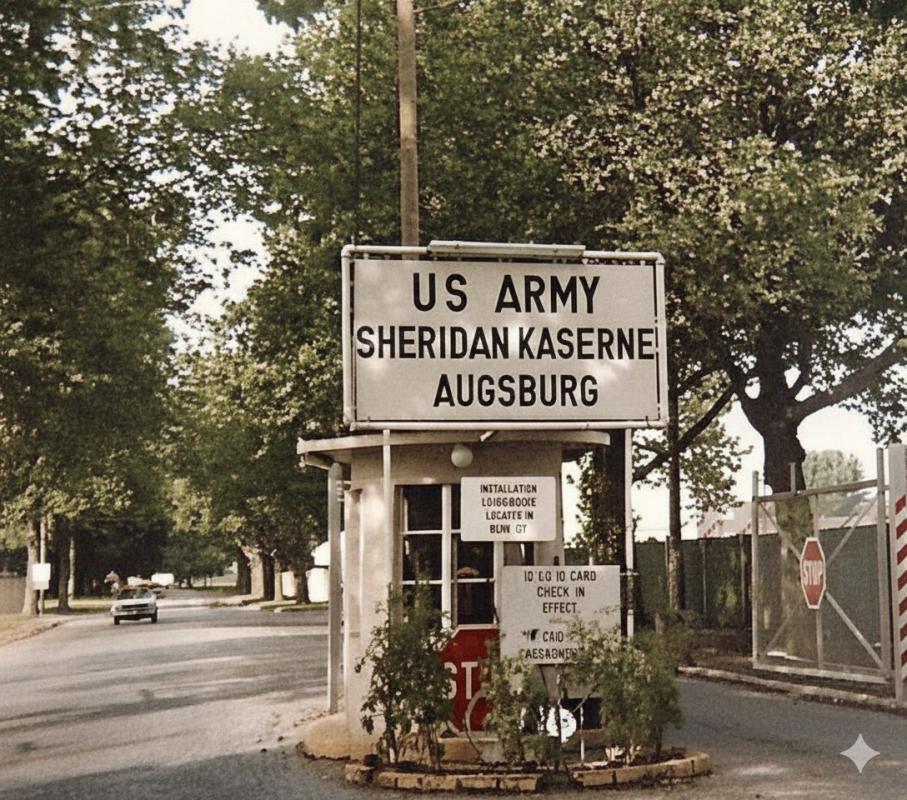
Barracks main entrance um 1975
After World War II, a huge area was created in the Pfersee district of Augsburg, in the west of the city, comprising three former Wehrmacht barracks: the General Kneußl Barracks, the Army Intelligence Barracks, and the Air Force Intelligence Barracks. In 1953, the Americans named the complex “Sheridan Barracks” after Carl V. Sheridan, a soldier who was killed in action during the war.
Covering 67 hectares, it was the largest barracks in Augsburg. The Americans took over the site almost undamaged and continued to expand it. Among other things, guest houses, a church, a ballroom, a sports hall, and a bowling alley were built.
After the war, the occupying forces of infantry divisions were initially stationed here. Later, units of the military police, the 5th Regiment, were added. During the Korean War and the Cold War, mainly National Guard troops were stationed here.
From 1956 onwards, large parts of the paratrooper troops were housed in the Sheridan Barracks. In the following decades, various artillery units, the 3rd Battalion of the 63rd Tank Regiment, and security and intelligence services (eavesdropping and surveillance units) were stationed here. One special unit was the Naval Security Group Activity Augsburg, an intelligence unit of the US Navy, which was based at the barracks from 1973 to 1996.
The Sheridan Barracks had a special reputation. Many celebrations took place in the officers' mess, where important decisions were made. The large meadow to the south of the barracks was used for parades, helicopter exercises, and sporting activities.
Gradually, the Sheridan Barracks began to look as the original planners had envisioned. The dense greenery and military buildings created a unique atmosphere. The Americans felt at home here, and for many soldiers and their families, the Sheridan Barracks became a piece of home.
The barracks had two guarded entrances, one to the east, the Pfersee Gate, and one to the west, the Stadtbergen Gate. Until the late 1980s, non-Americans were only allowed to enter the barracks upon presentation of identification. Taxi drivers were exempt from this rule, as GIs were not big pedestrians except during maneuvers. They usually had themselves picked up at their accommodation buildings, even if they were only traveling short distances within the barracks. The favorable dollar exchange rate made this possible.
The Grasige Weg was originally a (grassy) dirt road connecting Pfersee and the southeastern part of the municipality of Stadtbergen. With the construction of the Nazi barracks in Pfersee in the 1930s, it became the dividing line between the Air Force Intelligence Barracks in the south and the General Kneussl Barracks and Army Intelligence Barracks in the north. In addition, the side roads leading to the barracks were paved with granite.
The 700-meter-long Kasernenstraße was lined with trees on both sides.
The avenue that developed as a result was preserved and maintained by the Americans. On hot days, Grasiger Weg served as a welcome shaded access road to the barracks on both sides. While Grasiger Weg served as an open access road to the individual barracks during the Wehrmacht era, the Americans closed off the road on both sides with checkpoints after combining all the barracks into the newly named Sheridan Barracks.
This resulted in the creation of the East Gate in Pfersee and the West Gate on the outskirts of Stadtbergen. With its magnificent avenue, Grasiger Weg shaped the character of the Sheridan Barracks. Outsiders entering the barracks complex felt as if they had entered another world.
| Ort | Augsburg |
| Autor | Regio Augsburg ... |
| Kategorien | Stadtbild Erinnern |
| Suchbegriffe / Tags | |
| Lizenz | Alle Rechte vorbehalten |
| Bildquelle | Verein Amerika in Augsburg e.V. |
| Urheber | Unbekannt |
| Urheber Vergleichsbild | |
| Lizenz Vergleichsbild | Alle Rechte vorbehalten |
| Zugeordnete Touren | Little America in Augsburg (DE) Little America in Augsburg (EN) |